


Services
Get A Quote
Call or text us at (512) 415-3932 or fill out the form on our contact page. We’ll schedule a time to come look at the property and give you a straight answer on what it will take.
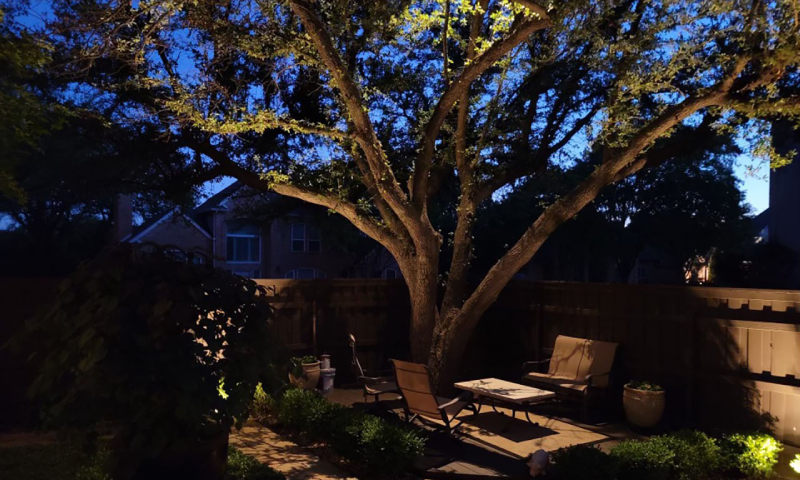
Moon lighting takes its name from the timeless effect it creates — low-voltage fixtures mounted high within a mature tree canopy, casting a soft, dappled glow across your lawn, driveway, or patio just like natural moonlight filtering through the leaves.
At Delta Outdoor Lighting, we design custom canopy lighting systems for Georgetown properties with mature, high-canopy trees—most notably live oaks, pecans, and elms reaching 25 feet or taller. Unlike standard uplighting, which draws the eye upward to highlight the tree trunk, moon lighting illuminates the ground below with a gentle, ambient radiance that feels entirely organic.
Curious if your mature trees are moon lighting candidates?
📞 Call (512) 415-3932 today to schedule your Free On-Site Consultation.
What Moon Lighting Actually Involves
By placing specialized low-voltage fixtures 25 to 35 feet up in a tree’s canopy, moon lighting solves a common landscape dilemma: the dark zone under dense mature trees. Without overhead lighting, ground beneath broad canopies remains completely pitch-black after sunset, regardless of how well-lit the surrounding property might be.
The Transformation: Before vs. After
- The “Before” State: Large live oaks create broad shadow umbrellas. Patios, lawn areas, and garden pathways under the canopy vanish into complete darkness after sunset.
- The “After” State: A soft, natural cascade of light breaks through leaves and branches, washing over lawn beds and outdoor seating areas with an enchanting, dappled pattern.
Arbor-Safe & Stealth Engineering
- Tree-Care Compliant Mounting: We use stainless steel screws when attaching mounts. We also offer non-invasive, adjustable strap brackets that wrap securely around branches without penetrating bark protecting your tree from disease or pest exposure.
- Hidden Daytime Aesthetic: Because fixtures and cables sit high above line of sight, moon lighting is virtually invisible during the day, maintaining the natural look of your landscape.
- Growth-Friendly Cable Runs: Direct-burial cable runs down the trunk loosely secured to avoid girdling as the tree matures, then routes safely underground away from surface roots.
Our 5-Step Moon Lighting Process
Step 1 — Canopy & Candidate Assessment
We evaluate canopy height, foliage density, and overall branch structure. Moon lighting requires dense branches to break up light beams naturally. If a tree’s canopy is too sparse or better suited for ground uplighting, we share that directly so you get the best outcome for your property.
Step 2 — Mounting Point and Fixture Selection
We select strong, accessible lead branches that can comfortably support a fixture, then choose low-voltage LED wattage based on canopy height and target ground coverage.
Step 3 — Non-Invasive Canopy Mounting
Fixtures are mounted using non-invasive, flexible hardware. As the tree grows, these straps can be easily adjusted during routine maintenance without causing damage or scarring bark.
Step 4 — Cable Routing and Underground Connection
Cable is secured down the trunk with room for trunk growth, then buried away from major root flares as it routes to your low-voltage transformer.
Step 5 — Nighttime Aiming and Pattern Fine-Tuning
Moon lighting lives or dies by nighttime adjustment. We return after dark to fine-tune angles and positioning until the dappled light pattern falls naturally across your lawn or patio, then conduct a walkthrough with you to ensure complete satisfaction.
Serving Georgetown and the Surrounding Neighborhoods
Moon lighting thrives on properties with mature, established shade trees:
- Historic Old Town & San Gabriel Park: Perfect for sprawling, legacy live oaks near downtown Georgetown.
- Acreage Estates: Ideal for San Gabriel River Estates, Cimarron Hills, Berry Creek, and properties along the Williams Drive corridor.
- Preserved Canopy Neighborhoods: Excellent for homes in Wolf Ranch and surrounding areas that retained native trees during construction.
We also design and install moon lighting across Cedar Park, Leander, Round Rock, Westlake, and the greater Austin area.
Why Central Texas Homeowners Choose Delta Outdoor Lighting
- Signature Central Texas Expertise: Founded in 1994 by Mark Ledyard, Delta has specialized in canopy illumination for over 30 years, adapting techniques specifically for Central Texas live oaks and pecans.
- DarkSky International Standards: Downward-directed, shielded warm LEDs (2700K–3000K) create zero skyglow and keep light strictly on your property rather than shining into neighbor windows.
- Honest Consultations: We assess every tree individually. If a tree isn’t a good candidate for moon lighting, we’ll tell you up front and recommend better design alternatives.
- Ongoing Canopy Maintenance: Trees naturally grow and shift! We offer ongoing seasonal adjustment checks as part of our maintenance services to keep your beam patterns perfectly aligned year after year.
What Our Customers Say
“The moon lighting effect over our back lawn looks exactly like real moonlight through the trees — guests always ask how it’s done.”
— Yves S., Austin, TX
“Mark identified which of our trees would actually work for moon lighting instead of just installing it everywhere, which we appreciated.”
— Steve K., Cedar Park, TX
Explore Related Lighting Solutions
Moon lighting works best as part of a complete exterior design plan:
- Tree Lighting — Combine upward trunk illumination with downward canopy lighting on specimen trees.
- Landscape Lighting — Highlight garden beds, pathways, and turf borders beneath the canopy.
- Architectural Lighting — Accent stone or stucco facades sitting near lit trees.
- Patio & Poolscape Lighting — Add ambient overhead glow to outdoor living and poolside entertainment areas.
Frequently Asked Questions
What size tree do I need for moon lighting?
Moon lighting works best on trees with a canopy at least 25 feet tall and a strong branch structure. This gives the light beam enough distance and leaf volume to filter through and create the signature dappled moonlight effect.
Is moon lighting the same as uplighting?
No. Uplighting places fixtures on the ground aimed upward to highlight the trunk and upper canopy from below. Moon lighting mounts fixtures high inside the canopy aimed downward, illuminating the ground below with soft, indirect ambient light.
Will mounting fixtures high in a tree harm its health?
Not when installed by Delta. We use either stainless steel mounting screws or non-invasive, expanding strap brackets. Cables are secured with enough flexibility to allow the tree to grow without girdling branches.
Can you see moon lighting fixtures during the day?
Minimally. Because the fixtures and dark wire runs sit 25+ feet up within the leafy structure of the tree, they blend into the shade of the branches and are practically invisible from the ground.
How often do moon lighting fixtures need to be adjusted?
Because branches naturally grow and sway during storms, we recommend a routine seasonal check to verify beam angle and clearance.
Ready to Experience Natural Moonlight Every Night?
Partner with Central Texas’s premier outdoor lighting specialists.
 Call Us Today: (512) 415-3932
