


Services
Get A Quote
Call or text us at (512) 415-3932 or fill out the form on our contact page. We’ll schedule a time to come look at the property and give you a straight answer on what it will take.
Georgetown’s mature live oaks and pecans — some standing since before the city’s 1848 founding along the San Gabriel River — are often a property’s most valuable landscape asset, yet most go completely dark the moment the sun sets.
At Delta Outdoor Lighting, we design custom tree lighting systems that turn these majestic specimens into stunning after-dark focal points. Using arbor-safe uplighting and moonlighting techniques, we protect the long-term health of your trees while completely transforming how your yard feels at night.
Ready to bring your specimen trees to life after dark?
Call (512) 415-3932 today to schedule your Free On-Site Design Consultation.
What Professional Tree Lighting Actually Involves
Tree lighting uses specialized low-voltage fixtures — typically ground-mounted uplights at the trunk base or canopy-mounted moonlights higher up in the branches — to highlight bark texture, branching structures, and leaf silhouettes.
The Transformation: Before vs. After
- The “Before” State: Without lighting, even a magnificent 80-year-old live oak becomes a dark void against the night sky, its rich form and texture completely lost after dark.
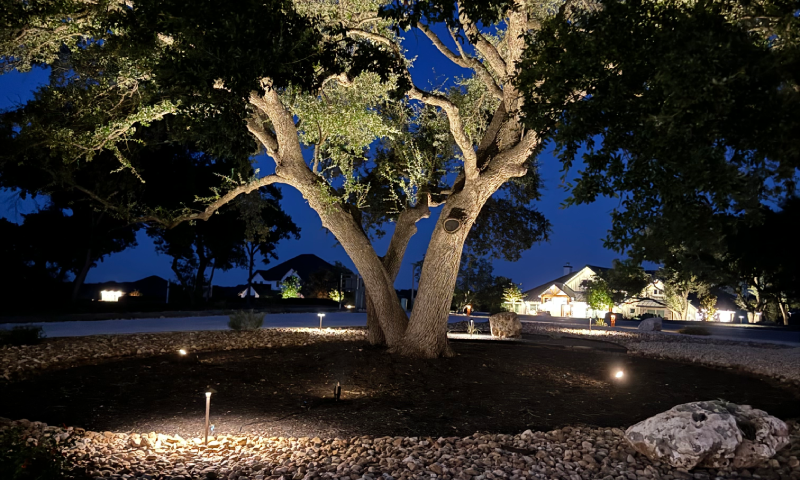
- The “After” State: A dramatic, multi-dimensional masterpiece. Trunk texture catches warm grazing light, limbs cast artistic shadows, and leaves glow with soft ambient radiance.
Root-Safe & Arborist-Approved Engineering
- Non-Invasive Tree Hardware: Fixtures attach with expanding, adjustable strap mounts that accommodate branch growth over time without opening bark to disease or pests.
- Texas AgriLife Root-Zone Care: Following guidance from the Williamson County Texas A&M AgriLife Extension office, we hand-trench wiring away from the critical root flare and major surface roots to protect your tree’s root system.
- Precision Energy-Efficient LEDs: Modern 5- to 20-watt low-voltage LED fixtures deliver clear, warm illumination (2700K–3000K) that reaches 30-foot canopies easily without overpowering the surrounding landscape.
Our 5-Step Tree lighting Process
Step 1 — Tree and Root Zone Assessment
We evaluate each target tree’s height, canopy density, trunk health, and root flare. Trees with dense, low canopies typically look best with uplighting from the base, while tall oaks with open upper branches are prime candidates for canopy moonlighting.
Step 2 — Technique and Fixture Selection
We select fixture wattage, beam spread, and non-invasive hardware tailored to the specimen. We match fixture materials (solid brass or copper) to endure Central Texas weather.
Step 3 — Low-Impact Root Zone Wiring
Because Georgetown’s shallow limestone pushes roots close to the surface, our crews hand-trench cable along natural bed lines — completely protecting surface roots and avoiding mechanical damage.
Step 4 — Mounting and Nighttime Aiming
Fixtures are secured using flexible, non-invasive brackets. We return after dark to hand-aim every beam, ensuring light filters naturally through the actual leaf pattern without causing harsh glare.
Step 5 — Ongoing Maintenance & Growth Plan
As trees grow, branches shift! Delta includes seasonal aiming checks in our maintenance programs so your lighting continues to look intentional and perfectly aligned year after year.
Serving Georgetown & Surrounding Neighborhoods
Central Texas features some of the finest native oak and pecan canopies in the state. We design around the specific landscape requirements of your neighborhood:
- Old Town & Historic District: Highlighting legacy oaks and pecans on established residential lots.
- Wolf Ranch & San Gabriel River Communities: Enhancing preserved native tree corridors built along the river basin.
- Berry Creek, Cimarron Hills & Acreage Estates: Custom multi-tree uplighting and moonlighting plans built for expansive properties along the Williams Drive corridor and Escalera Ranch.
We also design and install tree lighting across Cedar Park, Leander, Round Rock, Westlake, and the greater Austin area.
Why Georgetown Homeowners Choose Delta Outdoor Lighting
- 30+ Years of Arbor-Safe Expertise: Founded in 1994 by Mark Ledyard, Delta treats tree lighting as a specialized craft, prioritizing the biological health of your trees above all else.
- Tailored, Specimen-Specific Designs: We never sell generic “lighting packages.” Every fixture count, wattage choice, and beam angle is chosen specifically for that individual tree.
- Seasonal Adjustment Services: Because trees naturally grow, Delta offers ongoing maintenance and seasonal aiming services to keep your system looking flawless over time.
- Top-Rated Local Reputation: 5-star rated by homeowners throughout Central Texas.
What Our Customers Say
Explore Related Outdoor Lighting Solutions
Complete your outdoor lighting plan by pairing tree lighting with our specialized options:
- Moon Lighting — Cast soft, dappled moonlight downward from high within canopy trees over lawns and patios.
- Landscape Lighting — Illuminate garden beds, pathways, and turf borders beneath your lit trees.
- Architectural Lighting — Highlight nearby stone facades and columns sitting adjacent to mature trees.
- Patio & Poolscape Lighting — Extend warm, ambient lighting to your outdoor living and poolside spaces.
Frequently Asked Questions
Will tree lighting damage or hurt my trees?
Not when installed by Delta. We use non-invasive, expanding strap brackets rather than drilling screws or lag bolts into bark. Cable is hand-trenched clear of the root flare to avoid mechanical damage.
What’s the difference between uplighting and moonlighting for trees?
Uplighting places fixtures at the base of the tree aimed upward, highlighting the trunk texture and lower branch structure.
Moonlighting mounts fixtures high within the canopy aimed downward, creating a soft, dappled moonlight effect on the ground below.
How many fixtures does a mature live oak typically need?
Most mature live oaks utilize 2 to 10 fixtures depending on canopy spread and whether the design calls for base uplighting, canopy moonlighting, or a combination of both.
Do tree lighting fixtures need to be adjusted as the tree grows?
Yes, over time. As branches grow and foliage fills in, beam angles may need minor repositioning every 2 to 3 years.
Can tree lighting be installed on trees near my home’s foundation?
Yes! As long as wiring routes account for the root flare and existing utility lines. We assess these factors during our initial on-site walkthrough.
Ready to Turn Your Specimen Trees into Evening Art?
Partner with Central Texas’s premier outdoor lighting studio.
 Call Us Today: (512) 415-3932
