


Services
Get A Quote
Call or text us at (512) 415-3932 or fill out the form on our contact page. We’ll schedule a time to come look at the property and give you a straight answer on what it will take.
Architectural Lighting in Georgetown, TX
The 1911 Williamson County Courthouse commands its downtown square largely because of what happens to Beaux-Arts limestone after dark — shadow, texture, and depth that flat porch light can’t produce. Delta Outdoor Lighting designs architectural lighting for Georgetown homes and businesses that want that same effect: stone columns, stucco facades, and rooflines that read with dimension instead of disappearing at sunset. Architectural lighting differs from general landscape lighting in its precision — each fixture is chosen and aimed to reveal a specific surface, texture, or structural line rather than illuminate an area. Delta has designed these systems across Central Texas since 1994. Call (512) 415-3932 for a free design consultation.
What Architectural lighting Actually Involves
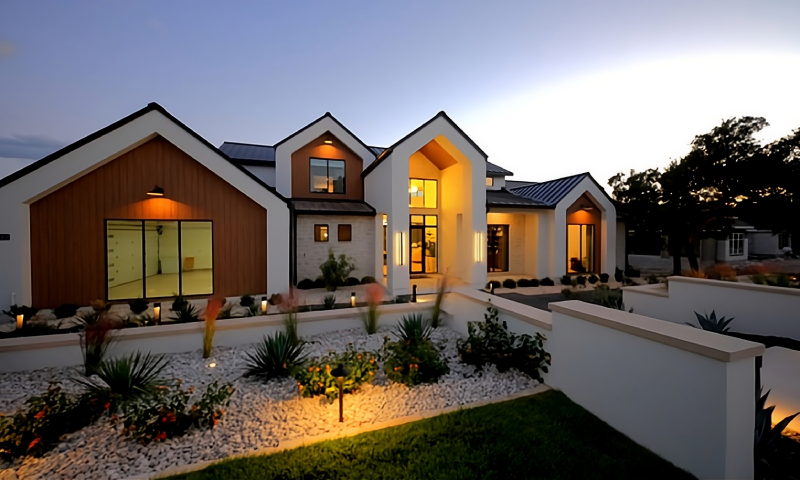
Architectural lighting is the technique of using aimed, low-voltage fixtures to reveal a building’s structure — columns, stone or brick texture, gables, dormers, and rooflines — through up lighting, down lighting, shadowing, and back lighting rather than broad floodlighting. Before a design goes in, most Georgetown facades read as a single flat plane after dark, with maybe a porch light and two garage sconces doing all the work. Delta’s design process identifies which architectural features actually benefit from light: limestone or Hill Country stone veneer takes grazing up lighting well, since the low, raking angle catches natural texture and casts shadow lines across mortar joints; smooth stucco often looks better with down lighting from eave-mounted fixtures, avoiding the washed-out look grazing light creates on flat surfaces; and mature trees near the structure can be back-lit to silhouette branches against a wall. Fixtures are typically solid brass or copper, chosen for corrosion resistance in Central Texas heat and humidity, and connect to the same 12-volt low-voltage system used in landscape lighting, keeping the whole property on one coordinated design rather than mismatched systems. The after state: a facade with visible depth after dark, where stone texture, roofline, and architectural detail read the way they were designed to in daylight.
Our Architectural lighting Process
Step 1 — Facade Assessment and Design Consultation
We walk the exterior in daylight to identify the property’s true architectural features — stone veneer, columns, arches, gables — and note which ones photograph well versus which ones are structurally significant but visually flat. A follow-up visit after dark, when possible, shows how existing security or porch lighting already affects the facade, so the new design works with, not against, what’s already there.
Step 2 — Fixture and Technique Selection
Each feature gets matched to a lighting technique: grazing up lights for textured stone, wide-beam wash fixtures for large stucco or brick expanses, and narrow-beam spotlights for columns or statuary. We select brass or copper fixtures for corrosion resistance and specify a color temperature of 2700K to 3000K so limestone and stone veneer read warm rather than institutional blue-white.
Step 3 — Precision Mounting and Wiring
Fixtures mount to grade stakes, wall brackets, or tree-mounted brackets depending on the technique, with cable run to keep each fixture’s beam unobstructed by future landscaping growth. Because architectural lighting depends on exact placement, we mock up questionable fixture locations with a temporary light before committing to a permanent mount.
Step 4 — Aiming and Beam Shaping
This is where architectural lighting is won or lost. We return after dark to aim every fixture, using barn doors, louvers, or lenses to shape the beam so light falls precisely on the intended surface without spilling onto windows, neighboring property, or the night sky above.
Step 5 — Integration and Final Walkthrough
The architectural system connects to the same transformer, timer, and photocell as any existing landscape lighting, so the whole property operates on one schedule. We walk the property with you after dark for final approval and adjustment before considering the job complete.
Serving Georgetown and the Surrounding Area
Delta’s architectural lighting work spans Georgetown’s older limestone homes in the Old Town and Belford historic districts near the courthouse square to the custom stone-and-stucco estates of Cimarron Hills and Escalera Ranch on the west side of town. Commercial clients along the I-35 corridor and around Wolf Ranch Town Center use architectural lighting to make a storefront or office facade stand out after dark, when foot and drive-by traffic is highest. Georgetown’s Hill Country limestone building material — the same stone quarried for structures like the county courthouse — takes uplighting particularly well, and our designers account for stone type and mortar color when selecting beam angle and fixture placement.
Delta also lights architectural facades throughout Cedar Park, Round Rock, and the wider Austin area; visit our website to see examples from completed projects.
Why Georgetown Homeowners and Businesses Choose Delta Outdoor Lighting
Mark Ledyard founded Delta Outdoor Lighting in 1994 with a design-first approach that treats architectural lighting as its own discipline rather than an upsell to landscape lighting — the two often share a job site but require different fixture types, beam control, and aiming technique. Every architectural fixture Delta installs follows DarkSky International’s Five Principles for Responsible Outdoor Lighting, which call for shielded, downward-aimed fixtures using warm color temperatures — a standard that keeps a dramatic facade from spilling glare onto a neighbor’s property or washing out the night sky over Georgetown’s residential streets.
Delta’s design team, profiled on our About page, has lit commercial and residential architecture throughout Williamson and Travis counties for more than three decades, and the company holds a 5.0 rating across Google, Yelp, Houzz, and Facebook. Fixtures are selected for solid brass or copper construction rather than painted aluminum, which corrodes and fades faster under direct Central Texas sun.
Systems are built on a shared low-voltage platform that can grow — many clients start with architectural lighting on the front facade and add landscape, tree, or moon lighting in a later phase, and Delta designs the initial transformer with the capacity for that expansion from day one.
Explore More Ways to Light Your Georgetown Property
Architectural lighting is most effective as part of a complete exterior lighting plan. Many Georgetown clients pair it with landscape lighting to carry the same warm, shielded design language into the yard, tree lightingmoon lightingpatio lighting and poolscape lighting pages.
What Our Customers Say About Our Architectural lighting
“From the first design conversation through installation, Mark’s team communicated clearly about what would and wouldn’t work on our stone exterior, and the final result matched what we’d discussed.”
— Yves S., Austin, TX
“We brought Delta in to light a commercial building and have since referred them to other business owners we work with.”
— Steve K., Cedar Park, TX
Ready to see your property glow after dark? Contact Delta Outdoor Lighting to schedule your free on-site consultation, or call (512) 415-3932.
Frequently Asked Questions
What’s the difference between architectural lighting and landscape lighting?
Landscape lighting generally covers a property’s plantings, pathways, and general yard illumination, while architectural lighting is aimed specifically at a building’s structure — stone texture, columns, rooflines — using techniques like up lighting, down lighting, and shadowing that require closer attention to beam angle and fixture placement.
What color temperature is used for architectural lighting?
Most residential architectural lighting uses 2700K to 3000K, a warm white that flatters limestone, stone veneer, and stucco. Cooler color temperatures above 4000K tend to look institutional on residential facades.
Will architectural lighting shine into my windows or my neighbor’s yard?
Not when it’s aimed correctly. Every Delta installation is fine-tuned after dark using shielding accessories to keep light on the intended surface, following DarkSky International’s shielding guidance to control spill and glare.
What fixture materials hold up best in Georgetown’s climate?
Solid brass and copper fixtures resist corrosion far better than painted aluminum under Central Texas sun and humidity, and both develop a natural patina over time rather than chipping or fading.
Can architectural lighting be added to an existing landscape lighting system?
Yes, as long as the existing transformer has spare capacity. Delta evaluates the current system’s load before adding architectural fixtures and upgrades the transformer if needed.